
The Map is Not the Territory
Instead of WiM Weekly, I'll be releasing draft passages from my upcoming book each Friday going forward. Please let me know your feedback below, you could change the course of the book!

In choosing the right trailhead to start down the winding philosophical pathways explored in this book, there were three interlocking quotes that kept coming to my mind. They may seem disparate at first, but as you work your way through the book, their deeper relation will be revealed. With this in mind, the map seems like a natural place to start our journey.
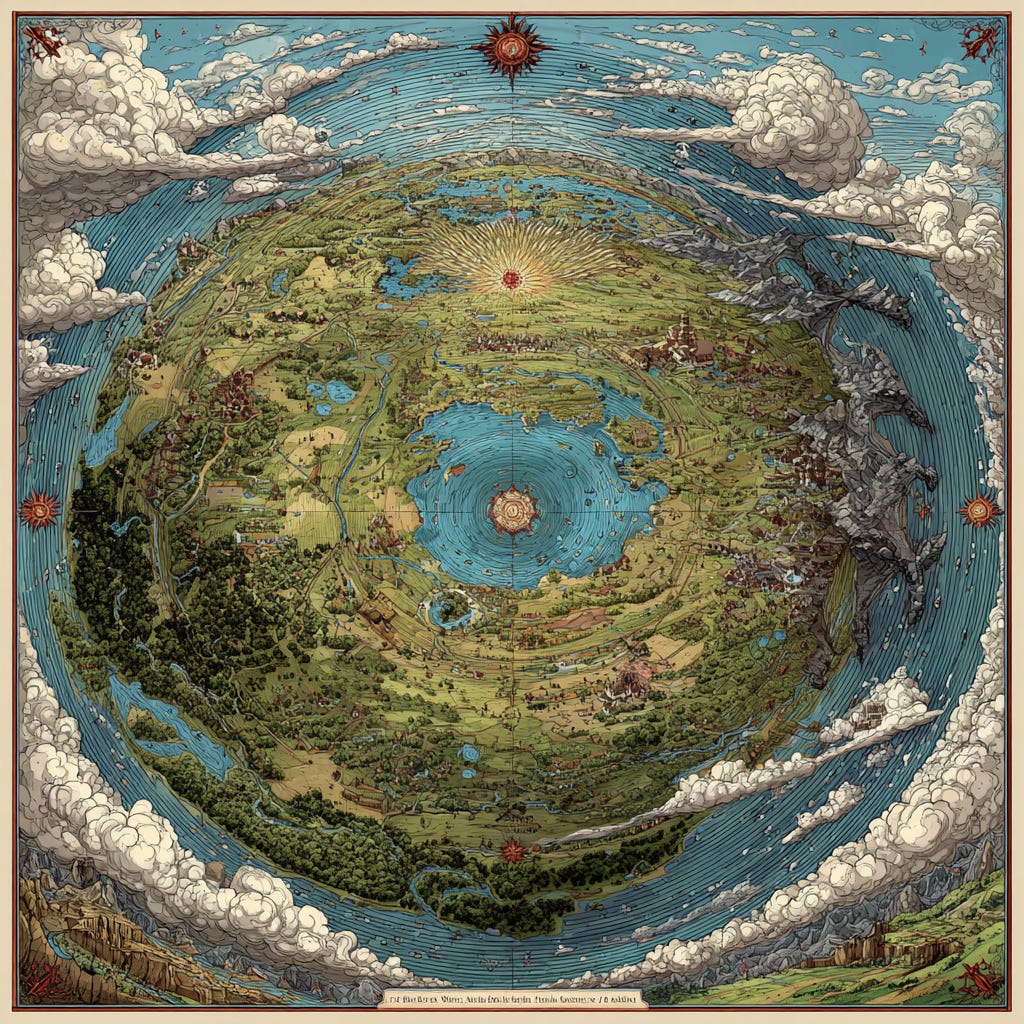
The Map is Not the Territory
“A map is not the territory it represents, but, if correct, it has a similar structure to the territory, which accounts for its usefulness.”—Alfred Korzybski’s 1931 paper A Non-Aristotelian System and its Necessity for Rigour in Mathematics and Physics
Maps offer a fascinating metaphor for the purpose of symbols. The word symbol, as it is used here, does not refer to religious symbols, but rather standardized markings that are widely understood to stand for something else. As a tool, maps rely on symbols to be useful. Maps may include a variety of symbols including the cardinal directions, lines of latitude or longitude, or perhaps polar coordinates. Originally hand written, maps classically were a collection of symbols useful for real world navigation. As a metaphor, symbols are maps to territories of varying kinds. Again, the word “symbols” here is used in the semantic sense: meaning, in relation to the way symbols refer to things in the real world. Metaphoric maps (symbols) and their respective territories (referents) are paired together in many different ways: such as menus to food, words to ideas, and money to wealth. Respectively, each is a map paired with its territory, or a symbol with its referent.
A symbol, in the semantic sense, is designed to refer to something beyond itself. Words, mathematical notation, diagrams, money—all operate as maps of something they are not. They’re valuable not because they are the thing, but because they point to the thing. Of course, “point to” in this sentence is metaphorical, as symbols cannot perform actions. What we mean is that symbols index to, or stand in for, referents. Again, this “standing in” is metaphorical, but as we will see, nothing that can be said is non-metaphorical. Symbols are a data-compressed versions of the things they symbolize, useful for thinking, communicating, and recordkeeping. Since we each experience the world through our own senses, and there’s no way to transmit this raw data across time or space, we must instead make use of symbols to encode aspects of our experiences for transmission to other minds across time and space. By compressing the natural complexity of the world into an orderly form, symbols are indispensable to human cognition, interaction, and social harmony.
However, a symbol is limited: it can never be the thing it represents. Metaphorically, we may echo Korzybski by plainly stating: the map is not the territory. Many people seem to live their lives unaware of this unbridgeable gulf between map and territory. The symbol and the referent can only touch in our agreements as to where they touch. Indeed, social agreement is the metaphoric touchstone of all symbols. The meaning conveyed by symbol-systems or languages is the alignment of minds confirmed by the coherence of their actions. When I say the word “dog” and you know that I am referring to the four-legged fury animal on the leash, then our minds are aligned and this word can coordinate our actions (ie. watch the dog while I grab his food). In other words, symbols are derivatives of our physical movements, meaning they reflect these movements, but are not identical. As this book will show, this derivation is true even for the loftiest of abstractions when their genealogy is traced far enough. At source, it will be seen that all abstraction (the map) originates in action (the territory). And although to abstract is itself a mental action, for our purposes it is useful to distinguish mental action from physical action.
In the gulf between the map and the territory the philosophical stakes are high. The symbol (the map) is indispensable because without it communication breaks down and our actions (the territory) cannot be coordinated effectively. Without maps, we are also limited in our ability to store and transmit knowledge. This is disruptive to the effectiveness of action, for as Aristotle said “the purpose of knowledge is action, not knowledge.” At the same time, any given map necessarily excludes many—or perhaps even most—aspects of its respective territory. So there are strict ontological (reality-based) limits on the reliability of maps. Here, extreme danger lurks. Those who foolheartedly believe that the map can be the territory think that their models of reality can override reality. Such fools buy into the idea of totalized knowledge: a set of symbols that contain reality in its totality. This is the intellectual hubris at the dark heart of totalitarian ideologies. So although we cannot dispense with the map, to mistake it for the territory can cause extreme human suffering.
Many brilliant thinkers have weighed in on this matter. As Ayn Rand said: “We can ignore reality, but we cannot ignore the consequences of ignoring reality.” In other words, you are free to falsify your own map or altogether ignore the territory, but the consequences of any such ignorant act cannot be ignored. Said simply: you are free to believe flapping your arms will make you fly, but you are not free to ignore the consequences of jumping off a skyscraper while flapping your arms and hoping to fly. Or as Carl Jung wrote “Evil is that which prefers being to becoming.” For Jung, blind faith in a fixed, final, and totalized state (being) is the refusal of growth, dynamism, and freedom (becoming). In short: evil insists the map is more real than the territory. Tyrants across history proved the malevolence of such totalitarian tendencies. With unwavering conviction in totalized knowledge, Mao, Stalin and Pol Pot ruled with iron fists, and decimated human lives in the process. Using a non-map metaphor to reemphasize the point: evil is the force that believes its knowledge is complete. This sentiment echoes the words of Nikolia Berdyaev, who wrote: “The root of evil is the aspiration to absolute perfection and to the absolute good, because it means the denial of freedom.” In this sense, the perfect map is antithetical to freedom, and freedom is essential to all human action. When someone believes their ideas are supreme, they will justify coercive means to make sure others live in accordance with them.
Every map is made up of lines and bounded by lines. These are the boundary conditions within each map, and between each map and the world. The metaphor of the map and the territory invites us to ask one of the most profound and important philosophical questions there is: where do you draw the line? Ultimately, this is a question we must continuously answer throughout our lives, both individually and collectively. This line of philosophical inquiry will take us on a winding path through areas such as literacy, numeracy, concept mapping, empiricism, ethics, politics, economics, and art. Establishing these metaphoric lines on and between our metaphoric maps is essential to intelligence. Learning to “read between the lines” is directly connected to the etymological origin of intelligence as “inter-ledger.” In this relational sense of the word, intelligence is the capacity to see between, beneath, and beyond the lines of the map into the actual territories they depict. In an action-centric sense, to be an intelligent actor is to be capable of goal-seeking, correcting errors along the way, and reserving the ability to change courses whenever necessary. There are many paths to the top of the mountain, yet the destination is only one.
Finally, the metaphor of the territory invites us to ask a profound question: what is the most fundamental territory in all of reality? In other words, where can we find ontological ground: the bedrock of reality itself? Pursuing this question will lead us into the idea of reciprogenesis. Reality is a mystery that reveals itself to us, just as we reveal ourselves to reality through action. The mystery of reality is manifest in self, other, and the world. Through technique and technology, we can generate revelations of reality that would not be otherwise possible. In the ground-stuff of reality we will encounter the essence of pure relationality: an ontology absent of all substance. Here we will encounter an etymologically accurate depiction of the universe as “one song.” The idea of music carries us into our next section based on a Tesla’s apocryphal quote about energy, frequency, and vibration.
With gratitude to my Sponsors:

Heart and Soil Supplements (discount code ROBERT): https://heartandsoil.co/
Blockware Solutions: https://mining.blockwaresolutions.com/breedlove
OnRamp: https://onrampbitcoin.com/?grsf=breedlove

Mind Lab Pro: https://www.mindlabpro.com/breedlove

Coinbits: https://coinbits.app/breedlove

The Farm at Okefenokee (mention BREEDLOVE for $21,000 off a custom cabin): https://okefarm.com/
Products I Endorse:
EFANI: Protect your mobile phone from SIM swap attacks: https://www.efani.com/breedlove
Lineage Provisions (code BREEDLOVE): https://lineageprovisions.com/?ref=breedlove_22
Colorado Craft Beef (code BREEDLOVE): https://coloradocraftbeef.com/
Jawzrsize (code RobertBreedlove for 20% off): https://jawzrsize.com
Salt of the Earth Electrolytes: http://drinksote.com/breedlove
Wow looking forward to this book, what a great explanation of "The Map is not the Territory" and its consequences in misunderstanding.
Why do some people prefer the artificial (map) to reality?
Made me think of a few quotes,
Hannah Arendt wrote of what she called ‘the future man’ that he seemed possessed by ‘a rebellion against human existence as it has been given, a free gift from nowhere (secularly speaking), which he wishes to exchange, as it were, for something he has made himself’.
David Bohm said, “So thought is an abstraction. Literal thought has this problem in it that, implicitly, it’s trying to say that it’s seeking the ideal of not being an abstraction, but just being another copy of what is. It is not leaving out anything. I think you can see that there’s always more, and we could say, therefore, by means of thought we could not capture the whole. That’s what I’m suggesting. We can always get more. There’s no limit to thought which you can set, because people could always discover more. Scientists could discover more and more and more. But still, it’s always limited. It’s limited because it doesn’t get all, right?”
What is most difficult, writes Arendt, is to love the world as it is. Loving the world means neither uncritical acceptance nor contemptuous rejection, but the unwavering facing up to and comprehension of that which is.
I am looking forward to the book! Great content across your platforms Robert.
Thank you for educating the public and fighting the Matrix programming🫡